
Surprising claim up front: a single extra screen before you sign a transaction can reduce your exposure to financial loss more reliably than many complex security add-ons. That counterintuitive idea — that friction, when well-designed, is security — is the best way to understand what Rabby brings to a DeFi power user in 2026. Rabby is not a marketing slogan; it is a deliberate set of mechanisms aimed at limiting blind signing, improving visibility across chains, and making institutional patterns (multi-sig, hardware wallets) work inside the browser flow that most traders and builders still use.
This article walks through a concrete case — an active DeFi user in the US switching between dApps across Ethereum, Arbitrum and BNB Chain — to show how Rabby’s transaction simulation, approval revocation, and multi-sig compatibility change the threat model in measurable ways. I explain the mechanisms that matter, compare trade-offs against prominent alternatives, surface limitations you must accept today, and close with practical heuristics a power user can apply immediately.
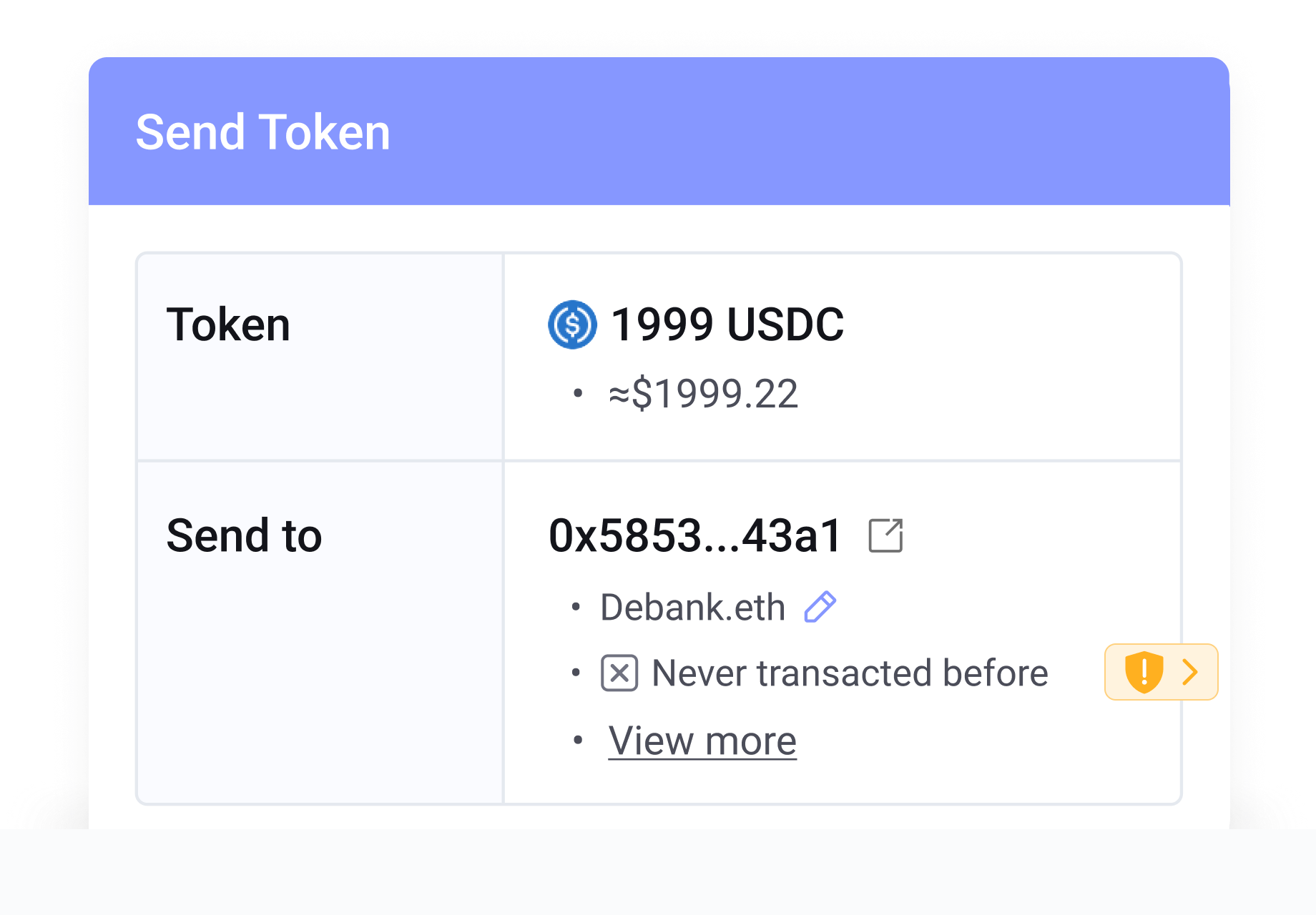
Case: a cross-chain DeFi trade and where blind-signing breaks trust
Imagine you are using a decentralized exchange on Arbitrum to swap ERC‑20 token A for token B, but your gas balance for Arbitrum is zero. In a typical flow with a generic extension, you approve the router contract, sign multiple transactions, and manually top up gas on another chain — each step is an opportunity for error or an exploit. Rabby’s value proposition addresses two mechanical failure modes in that scenario: blind signing (authorizing a contract without knowing exact state changes) and awkward network switching that causes the user to sign on the wrong chain.
Mechanisms at work: Rabby simulates the transaction locally and displays estimated token balance changes and explicit fee costs before the user signs. It also auto-switches to the correct EVM network when a dApp is detected, and provides a cross-chain gas top-up if needed. These are not cosmetic features: simulation reduces uncertainty about slippage and token flows, the revocation tool reduces long‑term allowance risk, and hardware wallet integration preserves cold-key security during signing.
How Rabby’s transaction simulation actually reduces risk (and where it doesn’t)
Transaction simulation works by building an off‑chain execution trace that estimates the effect of a transaction on token balances and contract calls. For the user, the salient output is: exact token change amounts and the gas fee estimate. That closes an important information gap: many approve-and-swap attacks depend on the user not realizing they just handed a contract unlimited token approvals or signed a transfer to a different recipient.
Limitations and boundary conditions matter. Simulation reports are estimates, not guarantees. They assume the on-chain state at the moment of simulation remains unchanged until mining — front-running and mempool reordering can change outcomes. Also, simulation cannot inherently detect logic errors in a smart contract where the contract itself behaves maliciously after deployment; it can flag previously hacked addresses or suspicious approval patterns through its risk-scanning engine but cannot prove a contract is “safe” in an absolute sense.
In short: simulation reduces information asymmetry but does not eliminate adversarial blockchain dynamics. Use it as a high-quality signal, not an oracle.
Where Rabby genuinely changes institutional workflows
Rabby is designed with both retail and institutional integration in mind. It supports multi-signature and enterprise custody flows (Gnosis Safe, Fireblocks, Amber, Cobo Wallet), and it integrates with popular hardware devices (Ledger, Trezor, Keystone, and others). For a US-based trading desk or DAO treasury, that means you can keep non-custodial control of keys while standardizing on a browser extension flow for interacting with dApps — a convenience that historically pushed teams toward custodial providers.
Trade-offs: integrating multi-sig and hardware means more UX complexity. Approvers must be trained to read simulations and to understand gas-topups and revocation mechanics. Rabby’s open-source MIT license mitigates vendor lock-in and allows external audits, but it also places the burden of secure configuration on teams. Institutional security improves when operational procedures, not just tools, are robust.
Comparisons, trade-offs, and a realistic positioning against alternatives
MetaMask, Trust Wallet, and Coinbase Wallet are well-known peers. Rabby differentiates itself by baking transaction simulation and automatic network switching into the core experience, plus a native revocation tool and a more explicit enterprise integration story. That matters for active DeFi users who repeatedly sign complex interactions across >90 EVM chains (Ethereum, Arbitrum, Optimism, Polygon, Avalanche, BNB Chain, etc.).
But it is not universal best-practice: Rabby currently lacks an in-wallet fiat on-ramp and native staking features, so if you need one-click fiat purchases or built-in staking dashboards you will rely on external services. Also remember the project’s operational history: a 2022 exploit tied to Rabby Swap cost around $190,000. The team froze the contract and compensated affected users, then increased audits. That episode underscores two truths: first, contract-level risk remains outside a wallet’s control; second, an active incident response and compensation can be a meaningful operational signal for governance and trust.
Decision-useful heuristics for DeFi power users
Here are five practical heuristics to apply when deciding whether to adopt Rabby as your primary browser wallet for DeFi work:
1) Treat simulation as the first line of defense. If a simulated token delta or fee looks off, pause and re-run; do not assume the dApp’s UI is accurate.
2) Combine Rabby’s revocation tool with monthly audits of allowances. Revoke high‑risk approvals after large trades or when you stop using a dApp.
3) Use hardware wallets for signing high-value transactions and multi-sig for treasury operations. Rabby’s hardware support makes this practical in a browser flow.
4) Expect auto network switching to reduce simple mistakes, but still verify the network and recipient address — automatic features can fail or be spoofed by tab manipulation.
5) Because Rabby is open-source, schedule periodic independent code reviews into your institutional checklist; openness helps, but it is not a substitute for active governance.
What to watch next — conditional scenarios
Monitor three signals that would materially change Rabby’s value equation for US DeFi users. First, broader adoption of mempool privacy techniques (e.g., private relayers) would strengthen simulation utility because outcomes would be less susceptible to front-running. Second, any reintroduction of fiat on-ramps inside the extension would change Rabby’s competitive set by lowering onboarding friction. Third, further integrations with regulated custody providers in the US could make Rabby attractive to compliance-minded funds — but that would require careful legal and operational work to avoid custody semantics that contradict non-custodial philosophy. Each of these outcomes is plausible; none are certain.
FAQ
Does Rabby completely prevent scams and phishing?
No. Rabby reduces risk by simulating transactions and alerting on suspicious contracts, and by offering approval revocation and hardware-wallet integration, but it cannot stop social-engineering, phishing pages, or contract-level exploits. Simulation is a strong signal, not a guarantee.
How does Rabby compare to MetaMask for a high-frequency DeFi trader?
For a high-frequency trader who signs many complex operations across chains, Rabby’s pre-transaction simulation and automatic network switching reduce friction-driven errors and invisible allowances. MetaMask is more ubiquitous, but Rabby’s security-first UX can reduce operational losses. The trade-off is that Rabby currently lacks built-in fiat and staking conveniences.
Is Rabby safe to use with hardware wallets?
Yes — Rabby integrates with Ledger, Trezor, Keystone, CoolWallet and others, allowing private keys to remain on the device while the extension handles the UX. That combination is a defensible pattern for high-value transactions.
What should institutions do differently when adopting Rabby?
Institutions should codify review procedures for simulations, mandate hardware signing for threshold amounts, route treasury transactions through multi-sig setups, and schedule independent audits despite Rabby’s open-source status. Tools help, but process secures value.
For power users who prioritize explicit pre-sign visibility, flexible multi-chain handling, and institutional integrations, Rabby is worth a careful trial. If you want to explore installation steps or official materials, begin with the project site for a clear, step-by-step browser extension install guide: rabby.
Comentários