
Imagine you are about to execute a complex swap and liquidity move across Arbitrum and Ethereum mainnet in one session, using tokens you aggregated from several protocols. You want to avoid blind-signing, the usual approval rat hole, and the pain of manually switching networks while keeping a hardware wallet connected. That’s the practical scenario Rabby Wallet targets: a non‑custodial, multi‑chain client that leans heavily on pre‑transaction checks and clear visibility into what a signed transaction will actually do.
This explainer unpacks how Rabby works for DeFi power users in the US, why certain design choices matter for security and workflow, where the wallet still constrains behaviour, and how to decide whether it deserves a place in your tooling. Expect concrete mechanics, trade-offs, and one decision framework you can reuse across other wallets.
What Rabby is built to do — mechanism, not marketing
At its core Rabby is a non‑custodial wallet developed by DeBank that runs as a browser extension (Chromium family), mobile apps (iOS/Android), and desktop clients (Windows/macOS). It explicitly targets the EVM universe: over 90 EVM‑compatible chains are supported, including Ethereum, BNB Chain, Arbitrum, Optimism, Polygon, and Avalanche. The architecture is open source (MIT), which matters because independent audits and community inspection are part of a credible security posture in this space.
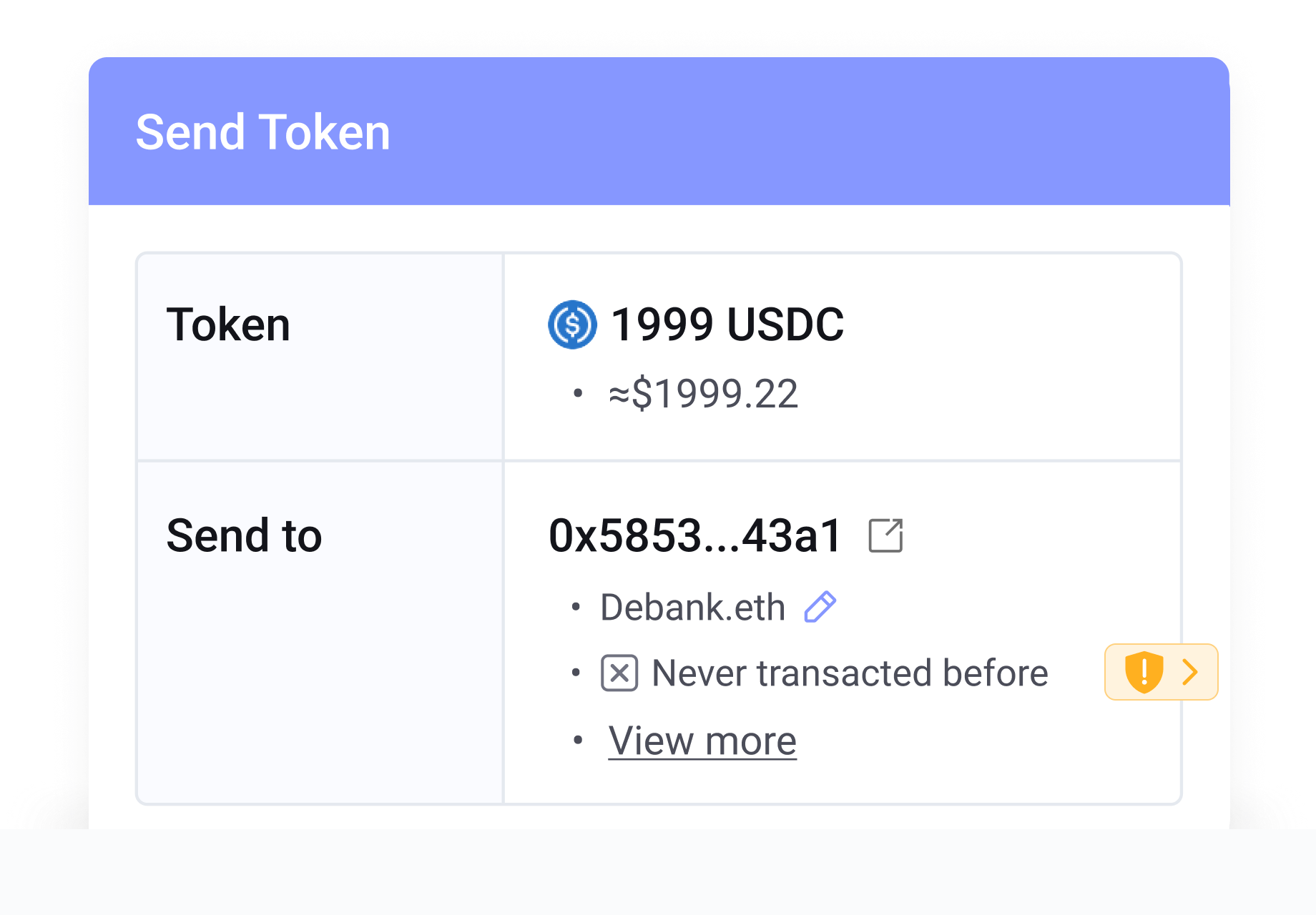
Two features explain Rabby’s distinctive user experience. First, automatic network switching: Rabby detects the dApp you visit and flips your active network to the one the dApp expects. That reduces manual errors when interacting with bridges, DEXs, or cross‑chain UIs. Second, transaction simulation: before you sign, Rabby runs a dry‑run, estimates token balance changes and gas costs, and displays them in human‑readable form. This simulation combats blind‑signing — signing a transaction whose effects you don’t fully understand — which is a frequent vector for asset loss.
How the security stack prevents common DeFi mistakes
Rabby’s security layer is pragmatic and layered. The pre‑transaction risk scanner flags red flags: previously exploited contracts, suspicious approval requests, and obviously invalid recipient addresses. A built‑in approval revocation tool lets you see and cancel token approvals that you may have granted long ago — a timely defense given how many hacks hinge on excessive allowances.
For institutional or higher‑assurance users, Rabby integrates with multi‑sig and enterprise custody solutions such as Gnosis Safe and Fireblocks. It also supports major hardware devices (Ledger, Trezor, Keystone, and others), enabling an air‑gapped signing flow while retaining Rabby’s UX benefits like simulation and automatic network switching. That combination — hardware signing plus pre‑transaction simulation — materially reduces the class of consent phishing and approval‑based exploits.
Where Rabby meaningfully changes the decision calculus — and where it doesn’t
Rabby is best understood as a risk‑reduction tool that improves the user’s information at the point of signing. The simulation converts a previously opaque blob of calldata into discrete, traceable outcomes: token in/out, fee, and approval changes. For a DeFi power user, that is a cognitive multiplier: you can compare what will actually happen to what the UI claims, and spot discrepancies before signing.
But Rabby is not a one‑stop solution to every DeFi friction. It currently lacks a native fiat on‑ramp — you cannot buy crypto with USD inside the wallet — and it does not offer native in‑wallet staking. Those gaps mean users still rely on third‑party on‑ramps and staking platforms. If you want to onboard dollars directly and stake within the same app, Rabby will not replace that flow today.
Trade‑offs and limits you should weigh
Automatic network switching is a convenience, but it has a trade‑off: automation can mask context. A wallet that flips networks for you also reduces the moment when users intentionally confirm they are moving to a different chain. Rabby mitigates this with clear UI signals, but a disciplined power user should still check network and contract addresses — automation reduces errors but doesn’t eliminate the need for human verification.
Transaction simulation is powerful, but it is bounded by oracle inputs and current chain state. Simulations can be inaccurate if mempool conditions change (sudden gas spikes), if contracts use on‑chain randomness or time‑sensitive logic, or when off‑chain dependencies alter execution paths. In short: simulation narrows the blind spots but cannot guarantee identical final outcomes in adversarial environments.
Practical workflows for power users
Here’s a short, reusable heuristic to decide when to rely on Rabby’s features and when to escalate controls: the 3‑P checklist — Preview, Pair, Permission.
- Preview: Always inspect the simulation output. Confirm the net token deltas and fees match your intent. If the simulated outcomes differ from the dApp UI, pause.
- Pair: For high‑value transactions, pair Rabby with a hardware signer. Let Rabby do the simulation and humanize the calldata; let the hardware device store the private key and approve the signature.
- Permission: Use Rabby’s approval revocation tool immediately after multi‑use approvals or once a strategy completes. Minimize long‑lived allowances to reduce attack surface.
These steps are compact enough to use before a farm harvest, a cross‑chain bridge, or a complex swap. They map directly to Rabby’s strengths: simulation, hardware compatibility, and approval management.
Comparative perspective: Rabby versus mainstream alternatives
MetaMask, Trust Wallet, and Coinbase Wallet are familiar comparators. Rabby’s distinctive claims are simulation and automatic network switching. MetaMask remains the dominant UI default and has broad dApp compatibility; Rabby’s ‘Flip’ toggle even lets users toggle which extension acts as the default — a practical concession to migration friction. For users prioritizing an additional layer of pre‑sign checks combined with wide chain support, Rabby is a credible alternative. For users who need fiat on‑ramp or integrated staking within the wallet, MetaMask companions or centralized custodial solutions remain more convenient.
Remember: open source matters. Rabby’s MIT license enables audits and third‑party tooling to integrate, which raises long‑term trust prospects compared with closed‑source alternatives. But open source alone is not a silver bullet — it depends on active review and a responsive security team, as the 2022 exploit of Rabby Swap showed. The team froze the exploited contract, compensated users, and increased audits after the incident. That response is informative: it demonstrates operational responsibility, but it also underscores that even wallets with security features can be entangled with risky smart contracts.
What to watch next — conditional scenarios and indicators
Near term, watch three signals that will materially affect Rabby’s utility for US DeFi users. First, any move to integrate regulated fiat on‑ramps would lower onboarding friction and expand Rabby’s addressable user base, particularly for US users subject to bank rails. Second, the addition of native staking features would reduce the need to juggle external staking interfaces. Third, continued integration with custody providers and institutional partners will push Rabby further into enterprise workflows.
Each of these developments would be useful but also introduces trade‑offs: on‑ramps and staking bring compliance and counterparty considerations; institutional integrations can require more complex permissioning and operational overhead. Evaluate any new feature in light of the 3‑P checklist above.
If you want to download or inspect Rabby and its documentation, a straightforward starting point is to visit the project page and extension listings; a quick convenient link is here: rabby.
FAQ
Does Rabby prevent all smart contract exploits?
No. Rabby reduces certain classes of user‑facing risk by simulating transactions, flagging risky contracts, and providing approval revocation tools. However, it cannot prevent flaws inside third‑party smart contracts or on‑chain events that change execution between simulation and confirmation. Users should still apply best practices: minimize allowances, use hardware wallets for large balances, and verify contract addresses off‑chain when possible.
Can I use Rabby with Ledger or other hardware wallets?
Yes. Rabby integrates with a wide range of hardware devices (Ledger, Trezor, Keystone, CoolWallet, and others). Pairing Rabby’s UX and simulation with hardware signing combines visibility and key security — a useful pattern for high‑value DeFi operations.
Is there a fiat on‑ramp inside Rabby?
As of the current feature set, Rabby does not offer a native fiat on‑ramp to buy cryptocurrency with USD inside the wallet. Users should use external on‑ramp services and transfer tokens into Rabby, watching for compliance and KYC implications when using US payment rails.
How reliable are Rabby’s transaction simulations?
Simulations provide a much clearer picture than raw calldata, but they are not perfect. They assume current chain state and predictable contract behavior. Rapid mempool changes, on‑chain randomness, or off‑chain oracle moves can make a simulated result diverge from the final outcome. Treat simulation as a powerful alarm and an information filter — not as a mathematical guarantee.
Bottom line: Rabby makes a defensible, pragmatic contribution to DeFi tooling by converting opaque transaction blobs into readable outcomes, automating network switching, and offering operational controls like approval revocation and hardware integration. For a US‑based DeFi power user who values clarity at the point of signature and uses multiple EVM chains, Rabby reduces cognitive load and attack surface. It still needs to be combined with hardware signing, disciplined permission hygiene, and external on‑ramps or staking services where required. That combination — better information plus strong key custody — is the realistic way to shrink avoidable losses in an adversarial DeFi environment.
Comentários