
Many experienced DeFi users hear “browser extension wallet” and immediately think MetaMask: seed phrase, network menu, click-to-sign. That shorthand is useful but incomplete. Rabby Wallet comes from a different design intent: not to be a cosmetic re-skin, but to change the user’s decision interface around risk. For power users who move large balances, interact across many EVM chains, or manage institutional signers, those changes are not cosmetic — they alter attack surfaces, routines, and what “good operational hygiene” looks like in practice.
In the U.S. context — where regulatory scrutiny, institutional adoption, and software supply-chain risk are growing — understanding how Rabby reorients wallet behavior is a practical necessity, not a theoretical curiosity. This article explains the mechanisms that separate Rabby from alternatives, lays out the trade-offs and limits that matter to serious traders and treasuries, and gives a short operational framework you can apply today.
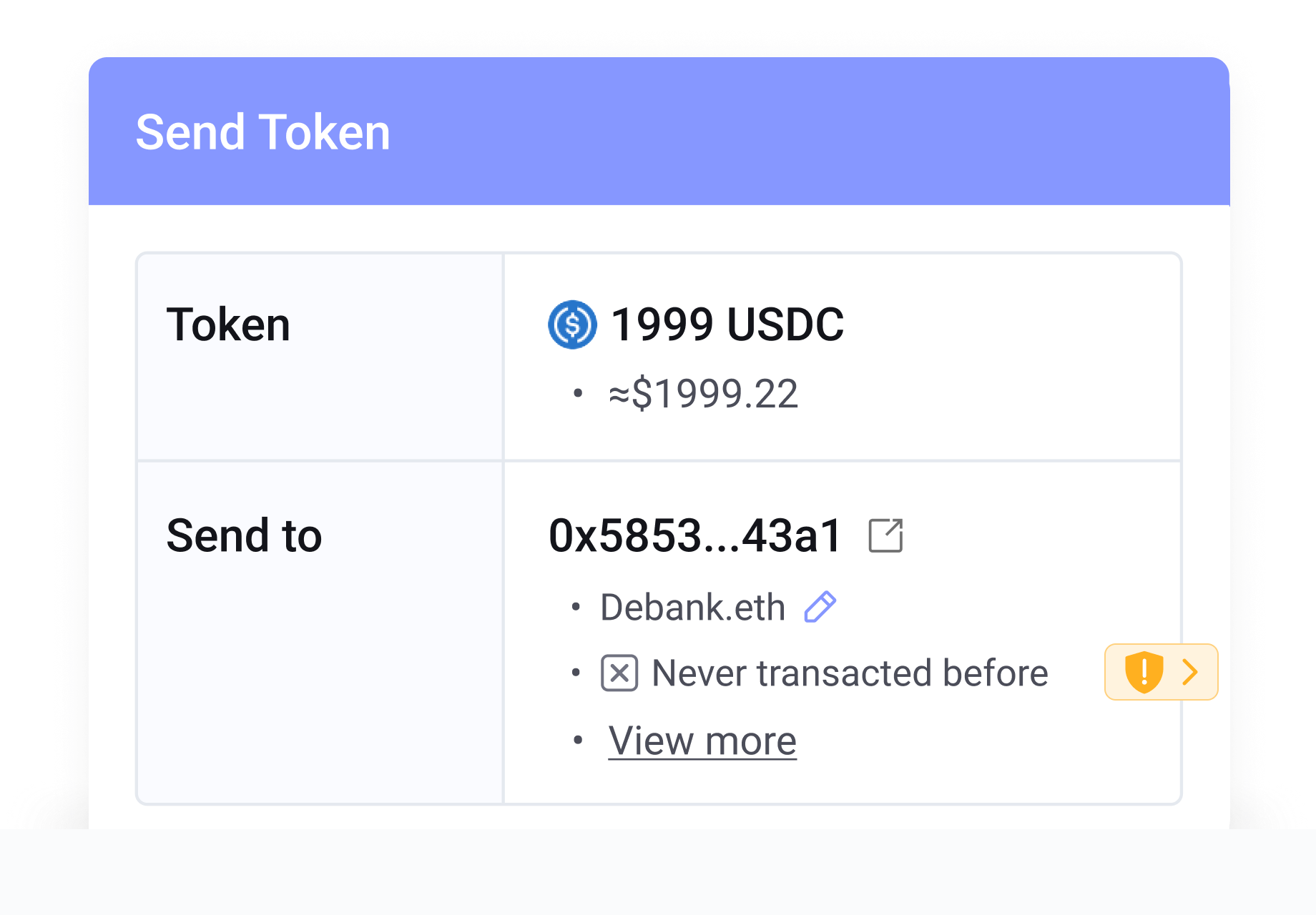
How Rabby changes the signing decision: transaction simulation and pre-scan mechanics
At the core of Rabby’s security proposition is a two-stage pre-commit process: (1) an automated pre-transaction risk scan and (2) a transaction simulation that reveals exact token balance deltas and fee estimates. Mechanistically, this works by inspecting calldata and contract addresses, cross-checking them against locally maintained and remotely updated threat intelligence (known-hacked contracts, suspicious patterns, non-standard approval calls), and then running a dry-run of the transaction on a node to estimate state changes.
Why this matters: the usual browser-extension flow exposes a user to “blind signing” — approving a transaction without knowing the final on-chain effect. Simulation converts opaque calldata into concrete outcomes: how many tokens will leave, which approvals are granted or replaced, and what the gas bill will be. For an experienced user, that’s a different class of guardrail: it doesn’t make you invulnerable, but it converts ambiguity into a visible variable you can act on.
Important boundary condition: simulation accuracy depends on node state and the transaction environment. If a dApp calls on-chain randomness, third-party oracles, or if frontrunning/bot activity changes state between simulation and submission, the simulated numbers can diverge from the final result. Rabby reduces the blind spot but cannot eliminate race conditions or external oracle manipulation; users must still factor in slippage limits and use time-sensitive safeguards when necessary.
Design trade-offs: usability, signal/noise, and where Rabby fits in your stack
Rabby’s feature set — automatic network switching, cross-chain gas top-up, approval revocation, and a portfolio dashboard across 90+ EVM chains — positions it as a utility layer for heavy DeFi workflows. But every defense introduces new operational trade-offs.
First, signal vs. noise: pre-transaction scanners must balance sensitivity and false positives. Too aggressive, and users develop “security fatigue” and click through warnings; too lax, and you miss real threats. Rabby’s practical approach is customization: users can import trusted lists, plug in institutional integrations (Gnosis Safe, Fireblocks) and lean on hardware-signers for final approval. For power users, that configurability is essential.
Second, dependency surfaces: automatic network switching improves convenience but increases the attack surface of the extension itself — a compromised extension could misroute networks. This risk is mitigated by open-source transparency (MIT license) and external audits, but open-source status is a hygiene factor, not a silver bullet. Independent audits and an active security program matter more than code availability alone.
Third, integration vs. custody: Rabby is non-custodial and supports many hardware wallets. For institutional operators, the integration with multi-sig and custody vendors is a pragmatic balance: Rabby handles human-facing UX and risk scanning, while custody solutions manage private key storage and high-value signing policies. That layered model reduces single-point-of-failure risk compared with a single-provider custody+UI approach.
What Rabby does well for U.S.-based DeFi power users — and what it doesn’t
Strengths: Rabby prioritizes pre-signature intelligence. For traders, liquidity providers, or treasurers who sign many approvals and cross-chain flows, the built-in revocation tool and approval visibility materially reduce exposure to lingering allowances — a common vector in hacks. Support for 90+ EVM chains and cross-chain gas top-up also reduces operational friction for multi-chain strategies that otherwise require maintaining small gas balances on each network.
Limitations: Rabby does not provide a fiat on-ramp inside the wallet, and it lacks native in-wallet staking primitives. Practically, that means U.S. users must rely on centralized on-ramps or other apps for fiat-to-crypto and separate staking flows for validator participation. Another real limitation is that pre-transaction protections are only as good as their threat intelligence; novel or targeted exploits that bypass signature-pattern heuristics can still succeed.
Historical cautionary note: Rabby experienced a smart contract exploit in 2022 involving Rabby Swap (~$190k). The team froze the contract and compensated users — and importantly, they subsequently increased audits. This episode is a reminder that even security-first projects are not immune to complex smart-contract risks; it illustrates the value of defense-in-depth rather than assuming any single layer is definitive.
Operational heuristics: a decision framework for power users
Here are four actionable heuristics to use when deciding whether to rely on Rabby for a given flow — a small decision framework you can apply immediately:
1) Classify the transaction by risk: low (portfolios rebalancing small amounts), medium (single-signer swaps >$10k, approval resets), high (multimillion treasury moves, contract deployments). Use Rabby’s simulation for medium and high operations, and require hardware or multi-sig confirmation for high-risk flows.
2) Treat approvals as time-limited privileges: use Rabby’s revocation tool to limit exposure. Establish a routine — e.g., weekly review of active allowances — and automate revocation where possible.
3) Combine static checks with dynamic checks: use Rabby’s pre-scan but also compare contract addresses against your own canonical list or your institution’s allowlist. Don’t rely solely on the wallet’s reputation database.
4) Layer hardware and custody: for sizable holdings, use Rabby as the operational UI while keeping keys in a hardware wallet or a custody solution. Rabby’s compatibility with Ledger, Trezor, and other devices supports this layered model.
Comparison snapshot: Rabby versus the familiar alternatives
Compared to MetaMask, Trust Wallet, or Coinbase Wallet, Rabby’s distinctive mechanics are the simulation-first flow and automatic network switching. MetaMask is broader in market penetration and has integrations across many dApps; Rabby deliberately focuses on making the signing decision more visible and less ambiguous. For institutional workflows, Rabby’s multi-sig and custody integrations make it a viable UI partner where MetaMask alone is insufficient.
That said, ecosystem embedding matters: many dApps optimize for the default user experience around MetaMask. Rabby’s automatic network switching reduces friction there, but you should still test complex app flows, especially on less common EVM chains, for edge-case behaviors.
What to watch next — conditional scenarios, not predictions
Three scenario signals to monitor that would change Rabby’s strategic value:
1) Improved in-wallet fiat rails: if Rabby or partners introduce a compliant fiat on-ramp built into the wallet, it would shrink the custody transition cost for new U.S. entrants — beneficial, but it would also increase regulatory scrutiny and operational burden.
2) Wider institutional adoption of multi-sig and custody APIs: deeper integrations (e.g., richer policy controls surfaced in the UI) would push Rabby from a heavy-user convenience tool toward an enterprise-grade front end; watch for tighter Fireblocks or Gnosis Safe workflows.
3) Enhanced on-chain real-time simulation fidelity: advances in fast state snapshotting or MEV-resistant submission paths could reduce the simulation-to-submission divergence and materially improve the protection that pre-sign simulations provide. That would make pre-commit checks more authoritative in time-sensitive trades.
For a straightforward place to download and test the browser extension, you can find Rabby Wallet resources and links here. Try it first with low-value transactions and pair it with a hardware signer if you hold material balances.
FAQ
Does Rabby eliminate the need for hardware wallets or multisig?
No. Rabby reduces certain behavioral risks (blind signing, unnoticed approvals) but does not remove the cryptographic role of private key custody. For high-value or institutional assets, a layered model that combines Rabby’s UX with hardware wallets or multi-sig custody remains the stronger defense-in-depth strategy.
How reliable are Rabby’s transaction simulations?
Simulations are useful and often accurate, but they are bounded by node state, mempool dynamics, and external oracle inputs. Use simulation as a reduction of uncertainty, not a guarantee. For time-sensitive or MEV-exposed trades, tighten slippage and use private submission channels where practical.
Can Rabby protect me from all contract exploits?
No wallet can protect you from every smart-contract vulnerability. Rabby’s pre-scan filters out many known risks and its revocation tool mitigates exposure, but novel zero-day contract exploits, faulty external contracts, or social-engineering attacks remain possible. Continuous audit practices, limited approvals, and conservative exposure limits are necessary complements.
Is Rabby appropriate for U.S.-based institutional users?
Yes, as an operational UI combined with enterprise custody and multi-sig controls. Rabby’s integrations with Gnosis Safe, Fireblocks, Amber, and Cobo Wallet make it suitable as a human-centered layer in an institutional stack, provided legal and compliance teams validate the combined architecture.
Comentários