
What would change if your browser wallet could show—not promise—what a transaction will do to your balances before you sign it? For DeFi power users who move money across chains, interact with unfamiliar smart contracts, and juggle multiple hardware keys, the difference between informed consent and “blind signing” is not academic. Rabby Wallet is designed around transaction simulation and risk scanning as primary defenses, and that design choice reshapes how you evaluate every other feature a wallet advertises.
This explainer walks through the mechanism, trade-offs, and practical limits of Rabby’s browser and extension ecosystem so you can judge whether it fits a US-based power user’s security model. It covers what Rabby does differently, where it still needs help, how it integrates into institutional workflows, and the realistic scenarios where its features materially reduce risk.
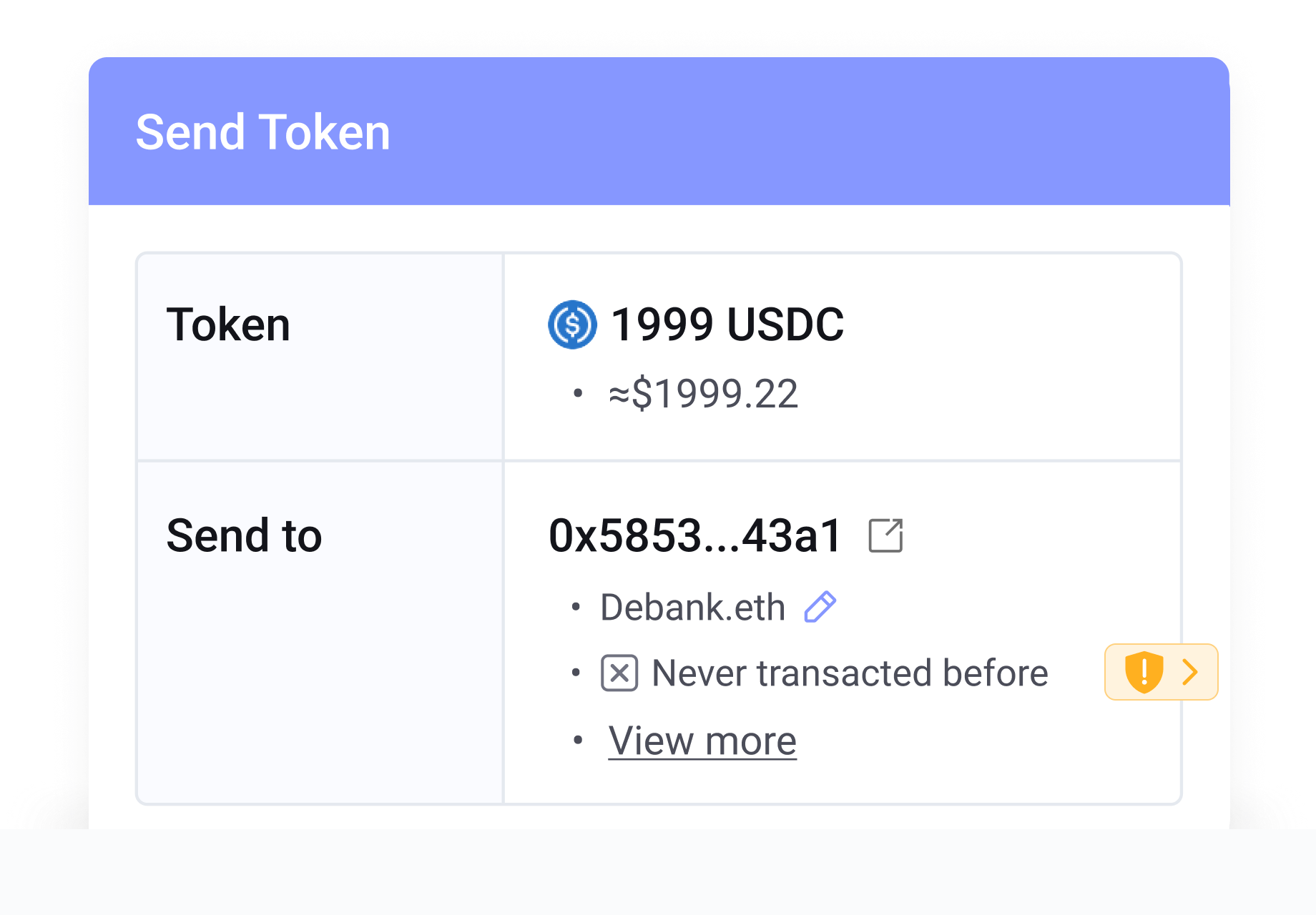
How Rabby changes the signing decision: transaction simulation and pre-scan
At its core, Rabby shifts responsibility upstream from the user to the wallet by simulating transactions before signing. Mechanically, the extension resolves what the smart contract call will do (estimated token transfers, approval updates, and gas costs) and presents that outcome to the user. This is not just a cosmetic readout: simulation reveals mismatches between what a dApp UI claims and what the underlying transaction actually performs—an increasingly common source of exploited approvals and tricked approvals in DeFi.
Complementing simulation is Rabby’s pre-transaction risk engine. It checks known hacked contracts, suspicious approval patterns, and non-existent recipient addresses and surfaces warnings. For a DeFi operator who routinely interacts with protocol contracts—LP migrations, zap contracts, or new bridging routers—these two mechanisms together reduce the probability of making a costly mistake. But reduce is not eliminate: simulations depend on accurate node state and ABI interpretation. If a dApp uses dynamically generated calls or an obfuscated proxy, simulation may be incomplete or misleading.
Multi-chain capabilities, gas top-ups, and where the UX saves time
Rabby is built as a multi-chain wallet for the EVM universe: over 90 chains are supported, and the extension automatically switches networks when you visit a dApp that requires a particular chain. For traders and arbitrageurs who hop between Ethereum, Arbitrum, Optimism, Polygon, BNB Chain, and Avalanche in one session, automatic network switching plus a cross-chain gas top-up tool can noticeably reduce friction. The top-up feature lets you send gas tokens to a chain where you have no native gas, preventing those embarrassing failed transactions due to zero balance on a target chain.
Beyond convenience, Rabby’s portfolio dashboard aggregates tokens, NFTs, and DeFi positions across connected chains—useful for reconciling exposure without manually querying block explorers. That said, Rabby deliberately omits an in-wallet fiat on-ramp and native staking controls. For U.S. users who want to buy crypto with a debit card or stake directly through the wallet, you’ll need external services. That design appears intentional: Rabby focuses on non-custodial DeFi interactions rather than becoming a single entry point for all crypto services.
Security posture: open-source, hardware compatibility, and a checkered past
Rabby is open-source under an MIT license, which invites independent auditing and community scrutiny—an important attribute for security-minded institutions. It also integrates with hardware wallets (Ledger, Trezor, Keystone, CoolWallet, GridPlus, BitBox02) and enterprise custody solutions like Gnosis Safe and Fireblocks. Practically, this means you can compose a security posture that combines Rabby’s UX (simulations, revocations) with the key security of a multi-sig or a cold key, reducing single-point-of-failure risk.
That combination is valuable because Rabby is not infallible. In 2022 a smart contract tied to Rabby Swap was exploited for roughly $190,000. The team froze the contract and compensated users, then increased audits. This incident is instructive rather than disqualifying: it shows the limits of any software-centric defense, the value of operational responses, and the necessity for users to combine tooling with principle-based safeguards (hardware keys, granular approvals, minimal exposure).
Practical trade-offs: what you gain and what you must accept
Rabby’s distinguishing features—transaction simulation, automatic network switching, and built-in revocation—address a specific risk set: misleading transaction payloads and permission creep. For an active DeFi user, those are high-leverage defenses. However, there are trade-offs you should weigh:
– No fiat on-ramp and no native staking: this keeps Rabby focused but requires additional services for purchases or for delegating stake. That means more operational steps and more surface area where mistakes can happen.
– Dependence on accurate simulation: simulation requires correct state, ABI parsing, and predictable contract logic. Complex or novel contract patterns can defeat accurate simulation, so a warning flag from Rabby is helpful but not definitive.
– User education still matters: tools help, but a misclick combined with an approved allowance can still be exploited. Rabby’s revocation tool reduces this window, but it relies on users actively managing approvals.
For more information, visit rabby wallet.
How Rabby fits into an institutional or high-security workflow
For institutions and power users in the U.S., Rabby makes the most sense as part of a layered architecture: use Rabby for its UX (simulations, revocations, automatic switching), pair it with a hardware key or multi-sig for signing, and route treasury operations through enterprise custody providers when required. Rabby’s integrations with Gnosis Safe and Fireblocks mean it can be slotted into these workflows rather than replacing them. That composability is a practical advantage: you don’t have to sacrifice operational controls to gain better transaction visibility.
Operationally, a good heuristic is: use Rabby as the “front-end sentinel” that warns and summarizes effects; use hardware or multi-sig as the “last-mile gatekeeper” that enforces quorum and limits.
Decision-useful heuristics and what to watch next
Three concise heuristics to decide if Rabby should be in your toolset:
1) If you interact with many smart contracts across multiple EVM chains and value pre-signature clarity, Rabby’s transaction simulation will materially reduce your accidental risk. 2) If you need an all-in-one consumer wallet (on-ramp, staking, custodial services), Rabby is partial—pair it with dedicated services. 3) If your operations require institutional custody or multi-sig approval, Rabby integrates well and can improve the interface for signers without becoming the security layer itself.
Watch for improvements in ABI disambiguation and simulation accuracy—those technical fixes would tighten Rabby’s core promise. Also monitor whether Rabby expands fiat integrations or staking features; doing so would broaden appeal but also change threat models and regulatory considerations in the U.S.
For readers who want to install and test the extension in a safe way, start by using it with a hardware wallet or a secondary account and try simulated transactions on well-known dApps before moving main funds. For a direct landing page and download options, see the project link to the official rabby wallet.
FAQ
Does Rabby prevent all smart contract exploits?
No. Rabby’s simulation and risk scanning reduce the chance you’ll accidentally sign a harmful transaction, but they do not prevent exploits in the smart contracts themselves or infrastructure-level attacks. Combine Rabby with hardware wallets, multi-sig, and conservative approvals for stronger protection.
Can I use Rabby across Chrome, Brave, and Edge?
Yes. Rabby is available as a Chromium-based browser extension and also as mobile and desktop clients for broader use. The extension’s automatic network switching is most useful in the browser environment where you interact with dApps directly.
Is Rabby suitable for institutional custody?
Rabby integrates with institutional solutions like Gnosis Safe and Fireblocks, making it suitable as an interface layer in institutional workflows. Do not rely on it alone for custody—use enterprise-grade custody providers for primary key management.
What are the most important limitations to know right now?
Two practical limits: Rabby lacks a built-in fiat on-ramp and does not provide native in-wallet staking. Also, simulations can be incomplete for complex or obfuscated contract calls. Treat Rabby as a risk-reduction tool, not a silver bullet.
Comentários